


Xsortex HUB
Capacitive Soil Moisture Sensor V2.0 Analog Waterproof Corrosion Resistant
Capacitive Soil Moisture Sensor V2.0 Analog Waterproof Corrosion Resistant
Couldn't load pickup availability
- Technical Support 24/7
- Same Day or 1-Day Shipping near Navi Mumbai
- Free shipping on Orders Above Rs 300/-
 Cash on Delivery available
- Original Product guarantee
- 7-Day Easy Return/Exchange

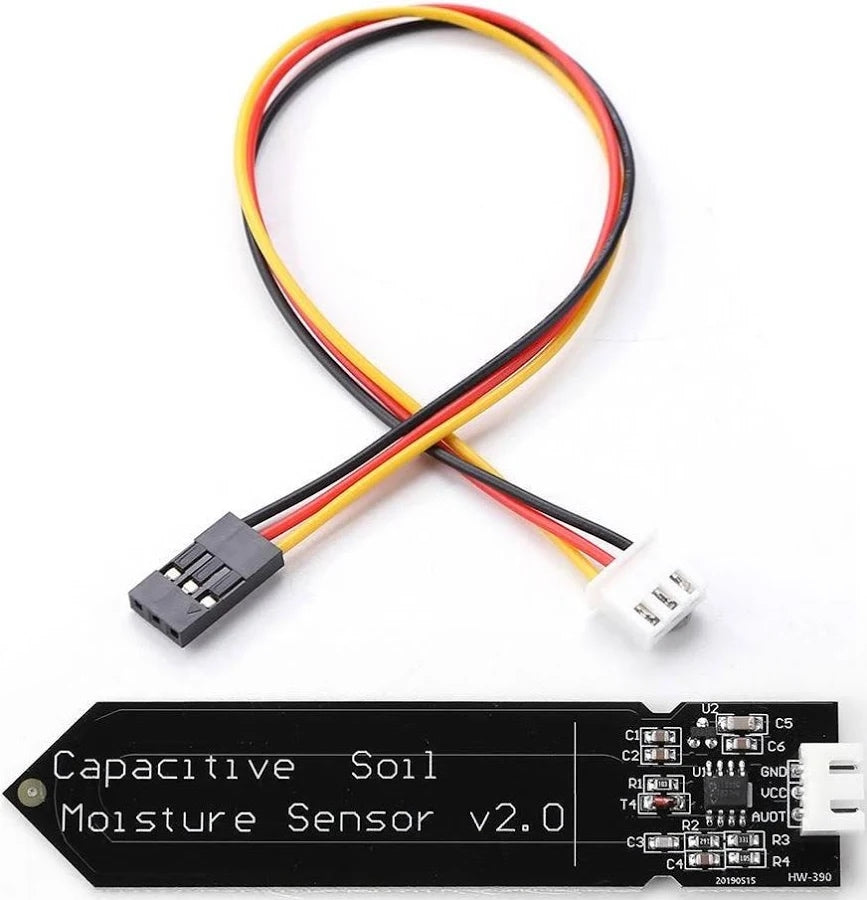
Capacitive Soil Moisture Sensor V2.0 – Analog, Waterproof & Corrosion Resistant
The Capacitive Soil Moisture Sensor V2.0 measures soil water content using capacitive sensing rather than resistive probes, making it significantly more durable and accurate over time. Unlike resistive sensors, it does not corrode or degrade in moist soil, ensuring reliable long-term performance in outdoor and greenhouse deployments.
Key Specifications
- Sensing Method: Capacitive (non-contact with soil)
- Output: Analog voltage (0–3.3V range)
- Operating Voltage: 3.3V – 5V DC
- Output Voltage Range: ~1.2V (wet) to ~2.8V (dry) at 3.3V
- Probe Material: FR4 PCB with ENIG coating (corrosion resistant)
- Cable Length: ~20cm with 3-pin Dupont connector
- Version: V2.0 (improved noise filtering over V1.x)
Compatibility & Use Cases
This sensor connects directly to any ADC-capable pin on Arduino, ESP32, NodeMCU, and Raspberry Pi Pico. Common applications include:
- Smart irrigation and automated plant watering systems
- IoT-connected greenhouse and farm monitoring
- Soil health monitoring for precision agriculture
- Home garden automation with ESP32 and MQTT
- STEM and environmental science project builds
Read the analog output with your ADC and map the voltage range to a 0–100% moisture percentage for intuitive display and threshold-based control.
Frequently Asked Questions
Why choose a capacitive sensor over a resistive soil sensor?
Resistive probes pass current through the soil and corrode within weeks or months. This capacitive sensor never makes electrical contact with the soil, so it keeps working accurately for years in pots, gardens and greenhouses.
How do I convert the reading into a moisture percentage?
Note the analog value in dry air (0%) and the value with the probe in water (100%), then use the Arduino map() function to scale readings between those two calibration points.
Does it work with the ESP32's 3.3V ADC?
Yes. Powered at 3.3V to 5V, its analog output stays roughly between 1.2V and 2.8V, which sits comfortably inside the ADC input range of ESP32, ESP8266 (with suitable scaling) and Arduino.
Can I leave the sensor buried in soil permanently?
Yes, the ENIG-coated probe is corrosion resistant and designed for continuous outdoor use. Keep the electronics end and connector above the soil line and away from standing water.
Order now from Xsortex HUB and get fast delivery across India.
- Choosing a selection results in a full page refresh.
- Opens in a new window.